
Patriarchy and Me
Life in a Snow Globe

Why Feminism Still Needs its Most Unfashionable Word
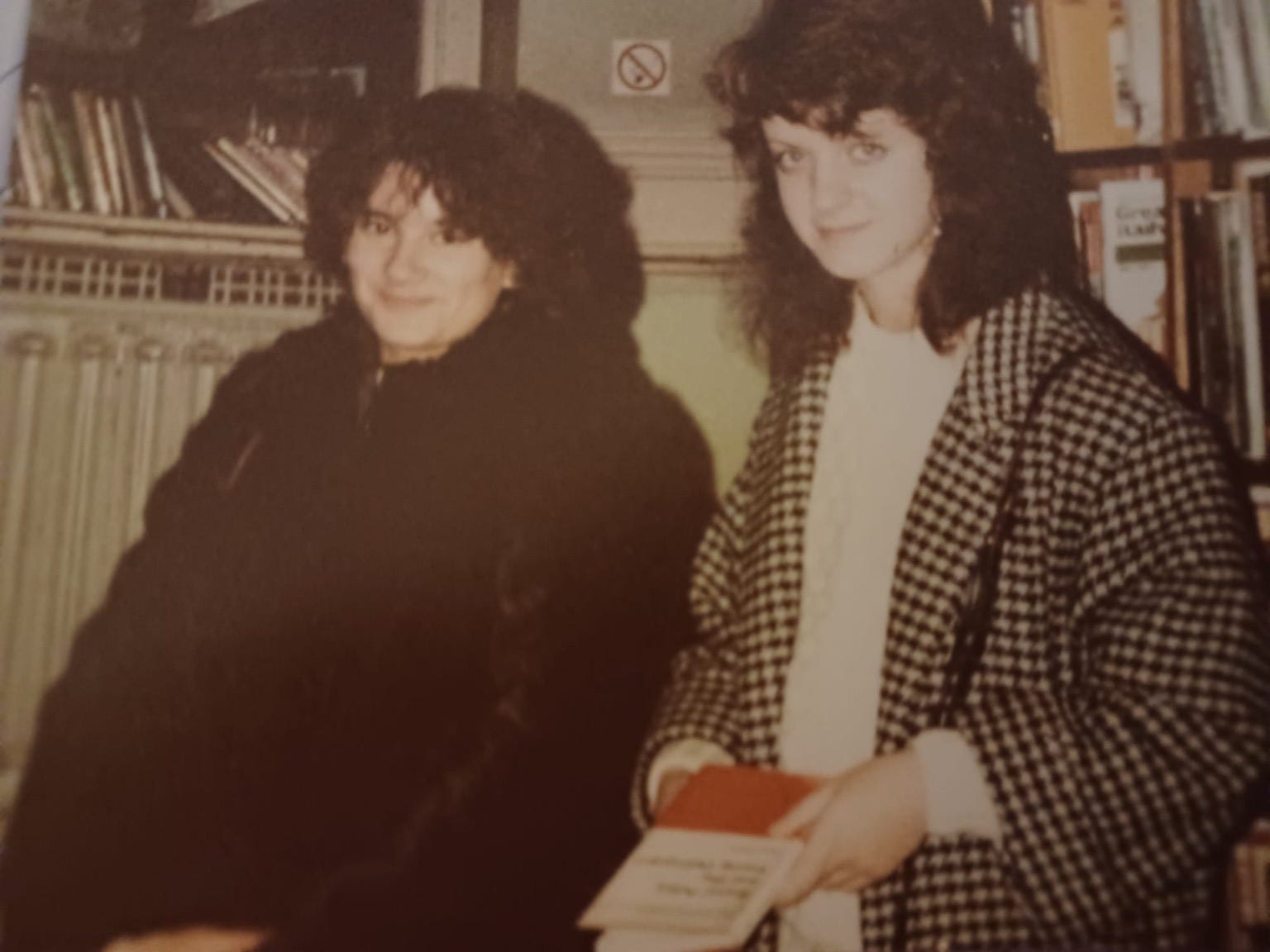
Delia and me, circa 1984
This week’s essay is a longer one, a personal and theoretical reckoning with patriarchy. It traces how the word first unlocked my own life, why it still matters, and what is lost if we let it go.
I was about seven years old when it happened. I was in the car, where Dad had driven us to the petrol station. Dad could still drive, just about, then; he propelled the car very slowly, as if through thick fog, and even though the other cars honked impatiently at us, I enjoyed riding in the car with him. There was a certain authority infusing the air, something defined by the scent of stale tobacco and vinyl; the feeling of being in a man’s world. As Dad paid and limped back to the car, he stopped to talk with a little balding man with a loud voice. After a few words at a distance, the man came closer, peered in at me sitting on the back seat and said to my father: “She’s not bad, is she?”
Meaning me.
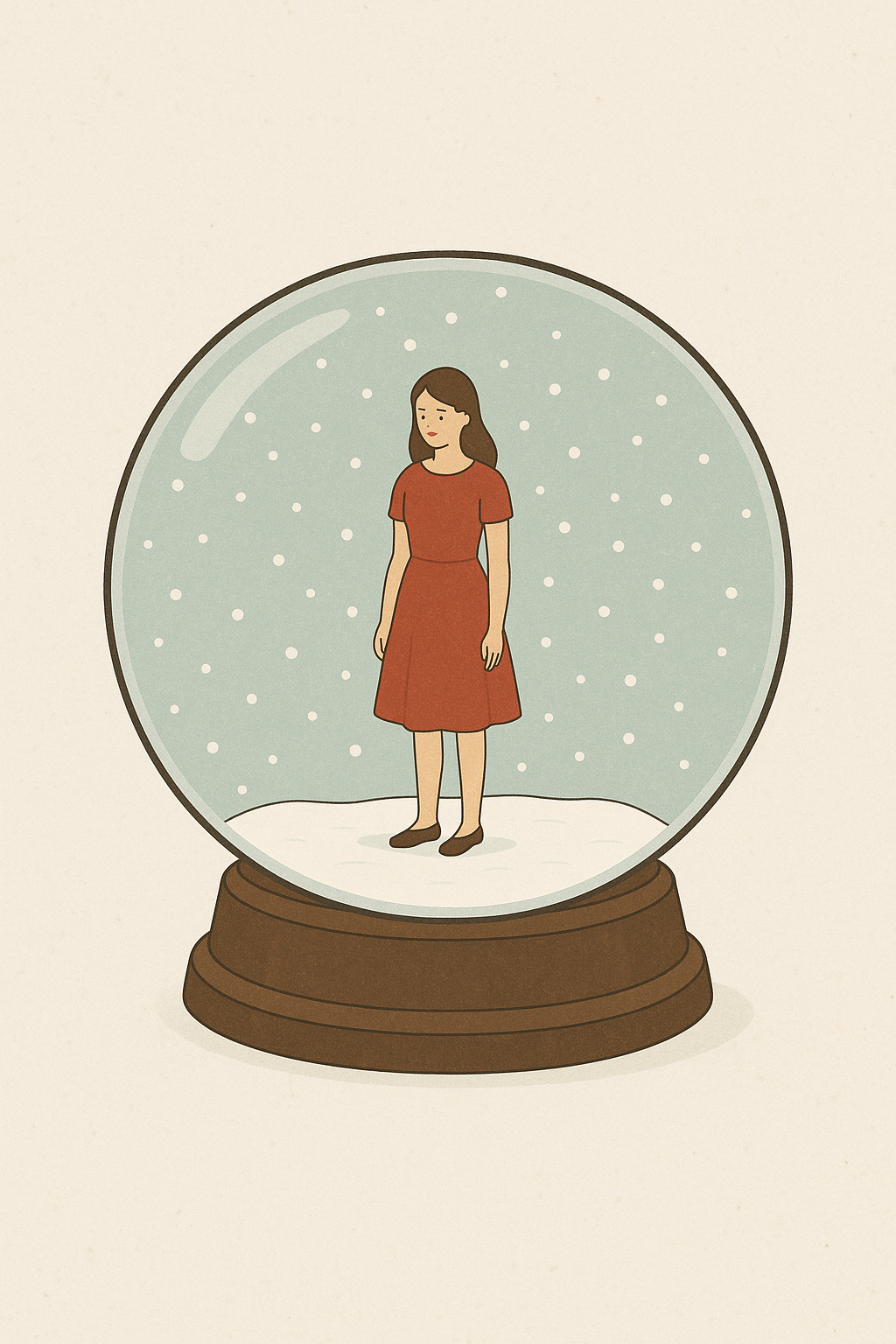
I cringed, burned, died at the idea of being thus assessed. Powerless on the hot vinyl seat, I resented it and yet wanted to be more than “not bad” all at once. That moment stretched infinitely; I was like a girl in a snow globe, the air turning into glass walls, the world contracting to that space, and it felt like I would be trapped inside it forever.
At home, I ran to the mirror and stared at myself as he had stared at me — coldly, critically, as if I were a stranger. From then on, the mirror became a tyrant. I no longer looked to see myself, but to check how I looked to others.
Later I would learn there was a word for this. Patriarchy.
Patriarchy Out of Fashion
The word patriarchy has ancient roots — “rule of the father” in Greek, and used in anthropology and archaeology by the 19th century to discuss evidence of a preceding matriarchal society. Engels was among the first to use it to describe the shift from matrilineal to patrilineal inheritance as the foundation of women’s subjugation in The Origin of the Family, Private Property and the State.
In early feminist thought, the idea of male domination certainly existed, with Mary Wollstonecraft talking about the concept without using the word itself. But the modern feminist sense — patriarchy as a pervasive social structure, not just an authority of fathers — crystallised in the 1960s-70s and probably the feminist writers most responsible for this in the Anglosphere are Kate Millett and Shulamith Firestone whose books both appeared in 1970. In Sexual Politics, Millett named and defined patriarchy as a system “whereby that half of the populace which is female is controlled by that half which is male.” Meanwhile, Firestone – bolder, more radical and utopian in her vision – wrote in The Dialectic of Sex of a “sex-class” system where men control women’s reproductive systems and benefit from their dependence.
For feminists like Millett, Firestone, Greer and others, patriarchy was the primary structure of domination: more fundamental than class, race, or capitalism. Some of the questions asked by feminists of the time circled around exploring and explaining its origins; its connection to capitalism, its relationship to class, race and other axes of structural oppression, and of course how to free oneself from it. For many feminists, the ending of capitalism seemed necessary, but this was far from sufficient, as daring Bolshevik revolutionary Alexandra Kollontai had shown. In her 1923 novel A Great Love and her 1926 Autobiography of a Sexually Emancipated Communist Woman, patriarchy reasserted itself strikingly and disappointingly amongst her revolutionary comrades.
By the 1980s and 1990s, though, the word, and the concept it described, was falling into disrepute. It was dismissed as too blunt, too universalising, too old-fashioned to account for women’s varied lives. Some of the most prominent thinkers of the day criticised it, most famously Judith Butler who shifted the emphasis to heteronormativity, suggesting patriarchy erases other oppressions. In her latest book, she even accuses gender-critical feminists like Kathleen Stock and J.K. Rowling of phobic projection. Their concerns about safeguarding are reduced to what Butler calls a "phantasmatic construal of the penis as weapon." Whilst you can’t have patriarchy without accepting sex differences, intersectionality also undermined the concept. It questioned whether anything so unitary a category as “woman” could share common experiences.
Meanwhile, in the contemporary manosphere, patriarchy enjoyed the contradictory fortune of either being dismissed as a fantasy or lauded as the natural order of things. Jordan Peterson rejects the term as an “appalling sociological doctrine,” linked to neo-Marxism, which neither reflects the role of natural hierarchies in human society nor the disadvantage suffered by many men. By contrast, for Steve Bannon patriarchy reflects the natural differences between men and women, and he thus sees feminism as an ideological tool to destroy western civilisation saying: “The anti-patriarchy movement is going to undo 10,000 years of recorded history.”
So, the word refuses to die. During the #MeToo movement, it bloomed again on banners and placards and the term has continued to feature in popular culture, for example in discussion around Greta Gerwig’s 2023 movie Barbie. For those (few) feminist theories which still embrace the term it is the only concept that explains, in our supposedly gender equal society, the enduring gender pay gap, the existence of everyday sexism, sexual violence and pornography, the fact that women carry out the preponderance of caring and domestic work. It explains too the fact that many women continue to support it, consciously or unconsciously, because of the benefits it offers (protection, valuing of youth and beauty) as well as its deep emotional resonance.
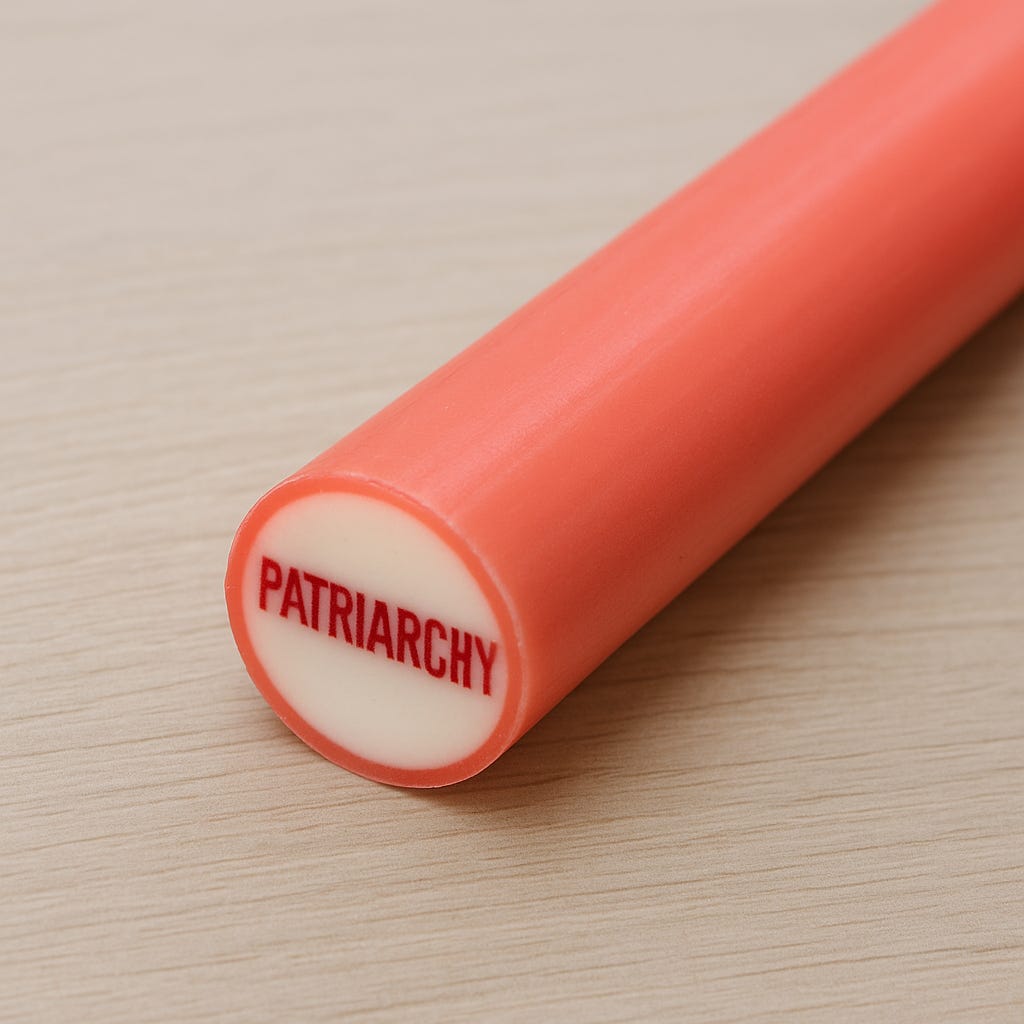
Paula England, former President of the American Sociological Association, in her well-cited 2010 paper: The Gender Revolution: Uneven and Stalled, points out that traditional gendered behaviour is maintained through cultural and economic barriers, and through both men and women holding onto traditional gender norms. For example, although more women began keeping their own surname in the ’70s and ’80s, this practice was always in the minority — never more than roughly a quarter among higher-educated women — and hasn’t increased much since then. She doesn’t mention the word “patriarchy” once, but its presence infuses the analysis, like the lettering through a stick of seaside rock: embedded in the centre, visible wherever you cut it.
And yet, without the term patriarchy, feminism is incoherent, adrift, unable to explain the interconnection and pervasiveness of women’s disadvantages, unable to explain why power keeps eluding us. It explains, too, why patriarchal structures assert themselves in the lives of young people identifying as “queer” who, not believing in the concept, are then completely defenceless, as Lillian Fishman explores in her novel Acts of Service.
When I first learned the word, it was like a key turning in a lock. The door opened, and things made sense at last. To lose it now is to throw away one of our sharpest tools.
Although Beauvoir herself is not usually credited with introducing the term, her analysis in The Second Sex remains, to my mind, the fullest and most intellectually and emotionally satisfying account of what patriarchy is and how it is reproduced in every generation through history. Both Millett and Firestone recognised their debt to Beauvoir, Firestone explicitly, dedicating The Dialectic of Sex to her.
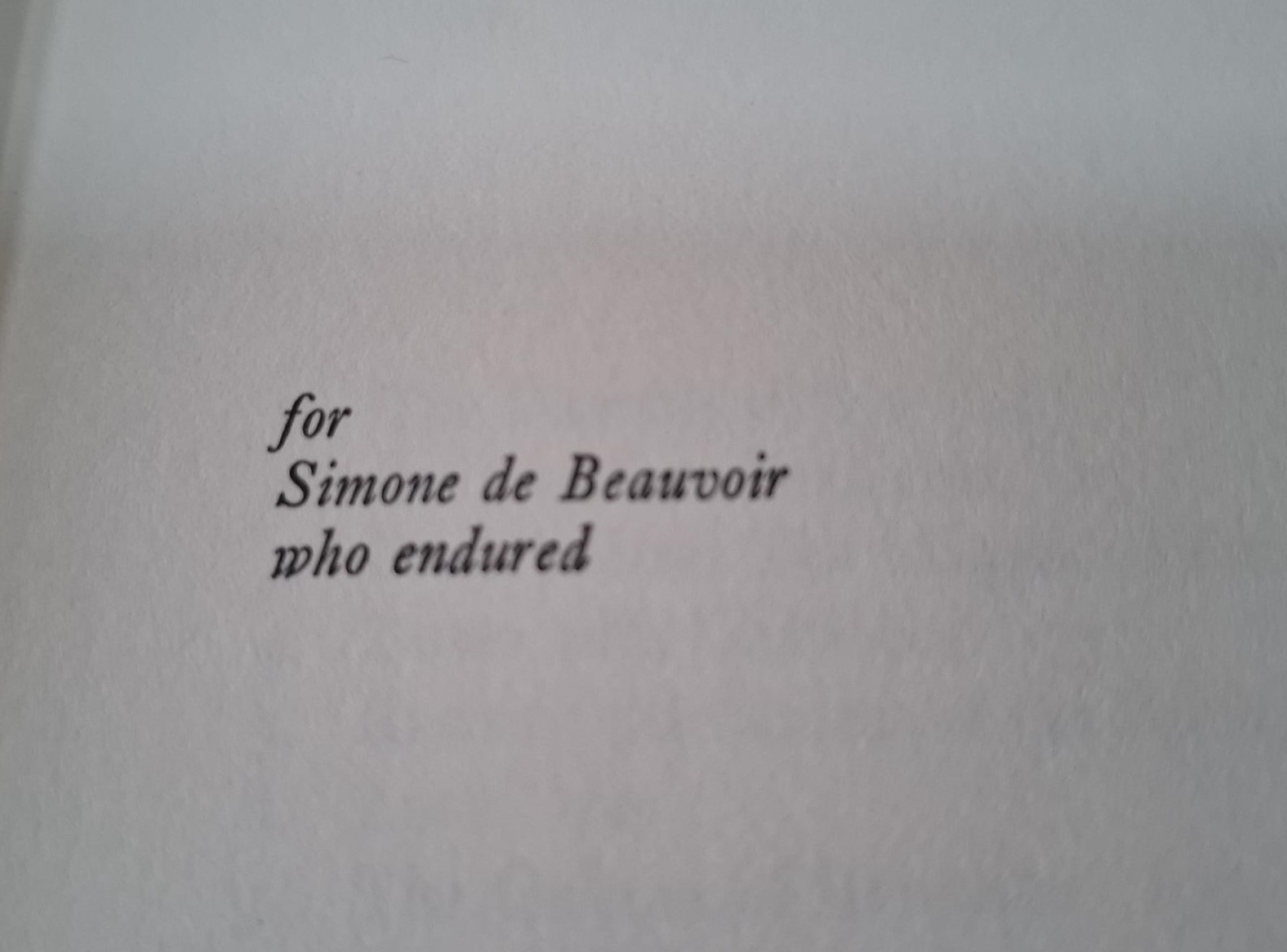
Dedication in the frontispiece of The Dialectic of Sex
What Kind of System Is Patriarchy?
Becoming a woman, in Beauvoir’s account, is to become the Other: defined in relation to man, never as fully oneself. Although feminists like Gerda Lerner and Riane Eisler had sought, in their own work, to explore the origins of patriarchy, for Beauvoir patriarchy isn’t a historical event with a fixed origin; not is it an “accident”. Rather, it’s a condition that is continually reasserted. That makes patriarchy different from other oppressions, like capitalism, or slavery. It has no clear beginning — and therefore no clean end.
It persists not only in structures but through myths of femininity: virgin or whore, angel or seductress, mother or monster. Beneath them lies objectification. Women are not only perceived as objects — they learn to see themselves that way. They become doubled: at once subject and object, active and passive, moving through the world while watching themselves move through it.
What makes patriarchy especially resilient is that women participate in it. We learn to want the very things that constrain us. The high heel that flatters also hobbles; its function and its restriction are inseparable.
Patriarchy is built and rebuilt in everyday life — in culture, habits, roles, expectations. It is not just inherited; it is lived, recreated every day. It is reasserted throughout the life course: childhood, adolescence, motherhood, menopause. At every stage, women are trained to please, adapt, defer. The expectations shift, but the principle endures: woman is defined in relation to man.
This is what makes patriarchy so durable — and so insidious.
Patriarchy Lived
When I was seven, a family moved into the flats on my street with a little girl of my age. Nahdia was small for her age, with a short pudding-basin haircut her mother had given her over the kitchen sink, identical to her brother’s hairstyle. She had huge brown eyes so alive they seemed to glow and a seriousness that I had never encountered before in a girl. Her father had come from the Middle East to do a PhD. I didn’t understand what that was at the time, I did not see him as an intellectual or as middle-class just a poor outsider, like us. Nahdia had to learn English from scratch but within a few weeks she and I were competing for who was top of the class.
As well as the most intelligent girl I had ever met, she was fearless, and good at everything I wasn’t – from gymnastics, to painting and sewing – and warm and generous with it – “I’ll teach you!” she would say to doing the splits, to using a paint brush, to sewing on a button. We became best friends. But it was more than that. It was like joining the orbit of a spectacular planet that had suddenly joined the solar system. Less courageous than Nahdia, she led and I followed, cautious but thrilled as she hacked out a path seemingly to an unstoppably brilliant future.
Her parents did not worry about her and that gave her a degree of freedom the girls in the semi-detached houses with the big lawns and extravagant plants - Pampas grass, monkey puzzle trees - did not have. We studied together, played out in the streets and deep in the woods till nightfall, making dens and throwing spears that we carved out of sticks we found. We even swam in the dirty stream where the traveller children splashed once a year when they came by, something strictly forbidden to the “nice” kids. At school, we were put in a special group of two, so far ahead were we, which made the other girls hate us. The mothers of the girls in the pampas grass semis came to demand from Miss Ace and Miss Bednarski why it was that we, the two girls from the rented flats, were doing better than their darlings, who had everything. “She’s the daughter of a Paki; she’s the daughter of a cripple,” we would hear the kids hiss behind their hands as we walked to school and back again together. We didn’t care. In fact, opposition made our friendship even more special.
But after that afternoon at the petrol station, something shifted. A new self-consciousness crept in. I could not throw the spear as far and as high as Nahdia. My limbs felt wooden, awkward, wrong. My body would never again be mine. And when Nahdia’s father finished his PhD and they left for their homeland, to a house with a courtyard in which a fountain played, I was left alone, in the rented flat, with a ruined forcefield, to face the world.
Henceforth I would become woman without an ally, without the protection of a co-conspirator.
Counter-Universe
At High School I tried to follow a man, my father. I wore the regulation blazer that no one else wore - too “square” - and carried a briefcase he had given me. It was a cheap version of the one he’d once carried in his days of triumph in Spain, before I was born, now taken with him to Highfields Day Centre for Handicapped Adults. A brilliant grammar school boy on scholarship, who had lost his own father and brother in the war and left school with nothing, he was my only model for a successful educational life. The briefcase was also my own inept commitment to the feeling of possibility that my friendship with Nahdia had given me. The other kids, sons and daughters of the working class, disliked it even more than they laughed at it.
I would come home at lunchtime, to get away from this, Dad warming me up a tin of soup until that became too much for him — the tail feathers of the man’s world, of masculine privilege, long since slipped from his grasp. We sat in the small kitchen, sharing an awkward silence, until the bell summoned me back to school, running full pelt, my pigtails flying.
I was bullied, of course, but I wasn’t afraid to fight if I had to. Besides, there is only so long you can use a briefcase as a shield. And here Beauvoir herself insists on the importance of fist fighting, like sport, in claiming a bold space in the world, in revolting against the given: “To lose confidence in one’s body is to lose confidence in one’s self,” she writes. For me, as for many girls, that confidence ebbed away at puberty.
I changed schools and changed again and when I was 14, as the smell of woodsmoke in the air heralded the despair of another school year beginning, I finally found another ally, when I met Delia. We were soon fast friends. She wasn’t particularly bookish. But what I relished in her above all, at this point in my life, was her fierce courage, a similar quality to Nahdia’s. Another rebellious girl, with a dark tangle of hair and an intense gaze, she lived on a farm. After school, she would go out on her black stallion galloping down the lanes and across the fields in the dark, lit only by faint moonlight. At day she was imprisoned at her school desk, at night she was free.
This was the time we were beginning to go out with boys and Delia’s allyship was of a different kind to Nahdia’s. We did what Beauvoir said: “negate male domination” by ridiculing the boys in our class, cutting their gaze down to size, especially the ones we liked. Together we worked out ways to navigate such dilemmas as the “free girl versus easy girl”—the only opinion we valued was that of each other. Delia plucked my eyebrows, and helped me henna my hair over the bathroom sink, and when she surveyed my new appearance, it felt like the mirror of the male gaze was filtered through her own, and somehow made tamer, more liveable.
We turned the tables on our boyfriends. We stood them up and went out to the cinema or to the beach after school on Friday night together where we would sit on the edge of Nash Point taking deep sweet glugs from a bottle of Lambrusco and watching the lighthouse flicker its warning across the bay. Delia taught me all sorts of stratagems to subvert masculine domination even though we couldn’t escape it, and indeed we were drawn to it, reluctantly and inexorably.
In Beauvoir’s view, the friendship between girls and women offers one of the most powerful ways of empowering them to resist patriarchal norms. What she wrote applied to me and Delia and it was limited, yes, but it was life-saving: “they do not discuss opinions: they exchange confidences and recipes; they join together to create a kind of counter-universe whose values outweigh male values; when they meet, they find the strength to shake off their chains...”
Why the Word Still Matters
Patriarchy, whether you name it or not, leaves its mark, sets traps in unexpected places, erodes even the most fierce of female selves. Nahdia did not go on to live the life of brilliant fulfilment that was hers by right. Her experience of constraint in a society which, once westernised, later adopted the burka and strict religious codes was the starkest of all of us. Somehow she managed to qualify as a doctor but chronic depression soon left her unable to work fully. What was most painful for her, she tells me today on our zoom calls, was how Western women refused to condemn these practices, refused to name patriarchy for what it is, wherever it exists. Delia too, for all her courage, did not find freedom within the three marriages she entered with her horse, and then his son, accompanying her into each one. Now, she tells me, menopause has brought her the sovereign self that patriarchy denied her as a young woman. Today I have another friend, a brilliant academic, with whom I commiserate over the peculiar combination of sexism and ageism that shapes our lives in the institution. How doors shut in our face because, just like in life, it appears that a woman can have too much experience, too much of a successful career behind her. And whilst the sound of doors slamming reverberate in the air, it is tempting to peer critically into my powder compact mirror and blame this on the deep hollows around my eyes and the marionette lines engraved indelibly now between my nose and my chin.
Naming patriarchy makes the invisible visible. Once you see it, you can’t unsee it. And once you name it, you can start to resist it.
Thank you for reading! If you enjoyed this, you can subscribe for free to get future essays straight to your inbox. And if you’re already subscribed, one of the best ways to support my work is to share this piece with someone who might value it.
Your writing is brilliant Susan, thank you for sharing it here.
Amazing and a fabulous read !!