

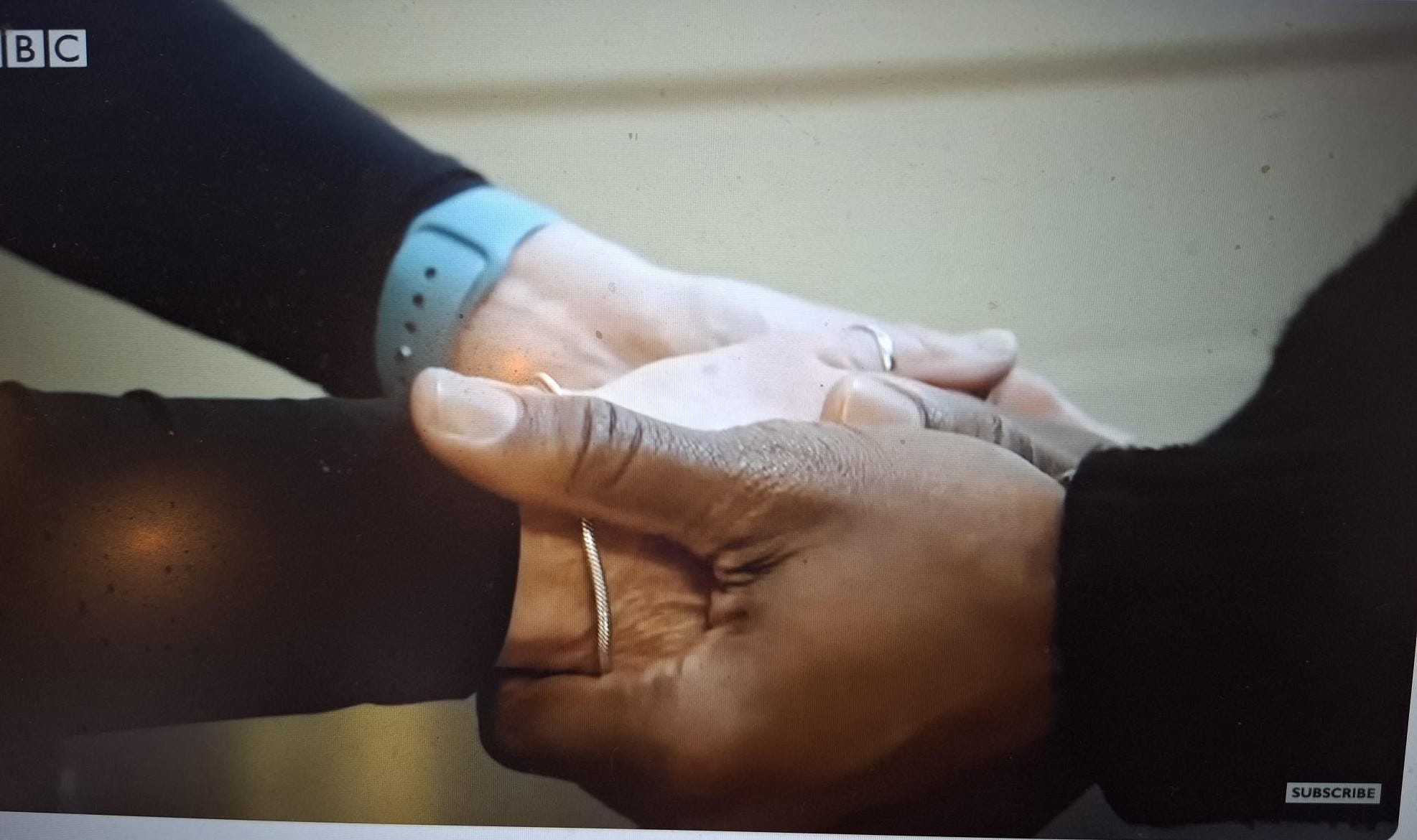
In the wake of Jason Arday’s tragic death, I have had two images swirling around in my head. The first is that image of Hilary Cremin welcoming Arday to Cambridge under the voyeuristic eye of BBC cameras: a sickly patronising softness which Tyler Austin Harper rightly deciphers as the “How far you’ve come and how kind I am for helping you go further” look. I have also seen the opposite of that in real time, incidentally, directed against the white poor, especially when they express the “wrong views”, where the cloying gaze cools and hardens into contempt. In this clip, the smile of the young Black man was wide-eyed, reminding me of a little boy in my primary school who used to whistle at the birds for hours on end. Then she grasped his hands and the camera lingered on the money-shot of their interlaced fingers, the grasp of the Black supplicant and the white benefactor. Three years later, Arday’s journey ended in a lonely death.
The second image is that of Henry Nowak, and by contrast to Arday, it was through his death that we – the public – first became acquainted with him. For him, it was the shoes that stuck in my mind. Not the white hands, pale as communion wafers in their obscene handcuffs, nor the pleading, dying voice, so much as the shoes: neatly polished, the black socks, feet splayed helplessly on the asphalt where he had huddled to hide from his killer. You could also hear his killer claiming that he had racially abused them, as he lies there, his lungs filling with blood on the cold asphalt.
The cause, in both cases, lies in a particular perception of the world. It is the approach which gives a hyper visibility to race as the factor according to which we view vulnerability, success, crime and achievement, and an invisibility to everything else, including the people it either praises or vilifies. In both cases, the individual is swallowed up in a category.
That approach has a name: critical race theory (CRT). It originated in the United States in legal studies, most notably through the work of Derrick Bell and Kimberlé Crenshaw, who argued that racism was systematised through ostensibly neutral legal frameworks. From there, it was taken up by education studies, in which field Arday was employed ultimately and which – like legal studies – treated racism as a norm rather than an exception.
Yet despite efforts to supply it with theoretical weight, CRT has remained more descriptive than explanatory, relying heavily on assertion and moral grammar rather than on falsifiable models specifying mechanisms, power structures, and direct material effects. The pervasiveness yet at the same time invisibility of racism as a structure means that different outcomes of any kind can be attributed to it: “If we truly believe that all humans are equal, then disparity in condition can only be the result of systemic discrimination,” writes Robin DiAngelo, summarising Ibram X. Kendi. If we ask: where is the human being in this, their choices and actions and struggles and efforts? And alternatively: where is the result of class, gender, age and so on, itself entangled with choices, actions and struggles? – the answer in both cases is “nowhere”.
Its significance, though mainstream in universities now, has spilled out into culture more generally. Academics increasingly use this to analyse problems of inequality in every area of life, often in a way that is “self-sealing” with everything fuelling it, even where white people experience the same or worse outcomes or where no evidence of racist policies or practices can be found.
In my seminar room, students use it as dextrously as hula hoops. In one seminar a couple of years ago, a young woman presented her work on critical race theory (CRT) to analyse the media coverage of O.J. Simpson. Simpson, she declared, was portrayed through ugly racist tropes in the media during his trial. They described him, in “racist tones”, she thought, as a man with “uncontrollable rages”, “obsessive jealousy” and “violent tendencies”. But she ended by confidently arguing that “O.J.” was the victim, whilst omitting the actual victims of the crime – a woman, long subject to domestic violence at his hands, and a young gay Jewish man. The problem was not that she noticed race at all but that the framework encouraged her to notice race first, race second and race third, until the battered woman and the murdered man at the centre of the story vanished altogether.
Similarly, as Harper observes in his Atlantic piece, Arday was fetishised both on the way up and on the way down; Nowak was not a boy who had been murdered senselessly on a night out but first a white racist and then a white victim.
This did not happen overnight. When critics complain that CRT was imposed on British police forces following 2020’s George Floyd murder and Black Lives Matter, they may not know that the intellectual soil was prepared in the UK to receive this argument sixty years ago. Some have blamed 1999’s Macpherson Report, which called the police institutionally racist in the wake of the Stephen Lawrence murder and led to significant changes in policing as a result. But the fact is, we need to consider the things we’ve taught students in criminology and sociology classes for literally decades and that arise from a specific intellectual tradition that has shaped British sociology for more than half a century. One key text responsible for this shift is 1967’s Race, Community and Conflict, by John Rex and Robert Moore. It was their work that first argued influentially that racism need not reside in racist intention, explicit prejudice, or openly discriminatory rules; that instead, it may be inferred from structures and outcomes, and therefore can operate without being directly visible.
They departed from Adorno and colleagues on the “authoritarian personality” on the basis that racism was structural not personal, writing on page 12: “Many students of prejudice have assumed that prejudiced beliefs about racial groups are to be explained in terms of this self-initiated action of the personality on the social environment.... [but] we had to explain why people who had not in the past shown racial prejudice began to do so in a new social situation. We therefore thought it necessary to explain this prejudice not in terms of the personality system but in terms of the social system, that is, in terms of a structure of social relations.”
Basing their fieldwork in Sparkbrook, Birmingham, Rex and Moore argued that local councils were racist for privileging long-term residents over newly arrived migrants in housing allocation. Under the 1948 British Nationality Act, new Commonwealth migrants were legally indistinguishable from locals, and their policies, they said, disadvantaged them. Here is the structural racism at play.
But surely any housing queue works like that; new arrivals are lower down the queue because they arrive last, not because of their race; and only a legal and linguistic sleight of hand could suggest otherwise. West Indians, they observe, came expecting “fair play” because moving to England for them meant moving to “the motherland.” What Rex and Moore classified as structural racism – prioritising long-established residents over newcomers – and portrayed as deeply unfair remains a rather unremarkable legal and cultural norm for many.
The move was, in one sense, quintessentially sociological. Rex and Moore wanted to replace an explanation of prejudice rooted in defective personalities with one rooted in social relations. They were also more nuanced in the way they deployed this, seeing distinctions not as monocausal with “race” as the master determinant but also pointing to the importance of class conflict and belonging in other social groups such as churches and political parties. Nevertheless, this move was consequential. Once racial prejudice could be understood as something generated or even “required” by a social structure, racism no longer depended conceptually upon finding racist individuals. The path was open towards the later idea of institutional racism: the possibility that a police force, a hospital or a university might be racist even where its individual members protested that they were not.
By arguing from the British nationality shared by Commonwealth citizens, however, the book also contributed to a conceptual shift whereby the “British” identity came increasingly to supersede English, Welsh, Scottish and Irish identities, erasing all differences between British subjects of Commonwealth origin and the English, Scots, Welsh and Irish who could lay claim to a specific ethnicity of their own and a relationship to their homelands which pre-dated that of other arrivals. “Whiteness” similarly does the trick. My grandmother – who rented a private house all her life, never received or expected a council house, and had lost both her husband and her son in the Second World War – died believing she was English. I think, if she returned to 2026 England, she would have been truly shocked to find out that she had become “white.” Everything she was, her community, her belief system, the individuals she loved and lost and who died fighting for their communities – all disappear into a vortex of abstract “whiteness”.
The book was no disinterested academic exercise; it was launched for maximum media impact, with a Café Royal lunch funded by the Survey of Race Relations, and it worked. Reviewed worldwide, debated by figures from Enoch Powell to the Archbishop of Canterbury, it became a set text in universities and schools across Britain. As one of the authors himself wrote forty years later: “I meet people in senior positions in public service occupations who remember reading Rex and Moore as students.” I can corroborate this, with academic colleagues recalling how Rex and Moore was a key book on their undergraduate reading lists. The problem is that, since the book was published, the argument has become more reductive, so that factors so important to their account – class, value, choice, gender – have disappeared. And where some people will call sociology itself to account for this, as indeed many have indicted sociology for being unable to tell poor scholarship from good in the case of Arday, this is not my argument at all: the answer is not no sociology but more of it (the rich and complex version, that is).
And so the move from the classroom, to the police training courses, to Jason Arday’s soaringly precarious elevation followed by his shattering collapse, to Henry Nowak lying crumpled on the floor in the cold December air, saying “I’ve been stabbed” and being answered with: “I don’t think you have, mate” is not a tragic aberration but a logical consequence. In each case, the rich, contradictory complexity of these individuals is rendered invisible, their hopes, errors, or yes, even crimes, reduced to a matter of black and white.
RIP Henry and Jason.
I hesitate to puff my own work but my book on CRT (Harris2024) -- on Amazon -- discusses Rex and Moore and several other British studies of racism and compares them favourably with CRT. I argue against the idea that 'racism' is the key structuring variable in British social structures. Read extracts free on Amazon, please. I have also been implicated in a 'vile campaign' against Arday because I contacted him about problems in his work (in 2023) in preparation for this book. Any criticisms of CRT must be racist, these people think.
I think what grates on me most is how the ‘white’ critique has replaced that of ‘class’ in Britain. We unlike the United States hail from a class society. It was class that segregated the people of Britain. One only has to reflect on the gruelling conditions experienced by the lower classes at the height of the British Empire ,the richest country in the world. That wealth was not shared. The poor were subjected to servitude, destitution or humiliation. The reality of the workhouses as the only social support available made as dehumanising as possible. That their descendants, me and the majority of the British, are now expected to be apologetic for their white superiority is an ignorant disgrace.