
When Germaine met Robert
Or, how feminists learn to live in the Valley

One Saturday night not long ago, my partner and I decided, on a wave of nostalgia, to watch The Song Remains the Same. For those who are not, or have never been, Zep fans, this is the footage of Led Zeppelin’s legendary three-night concerts at Madison Square Garden in 1973, interspersed with “fantasy scenes” chosen by each band member to depict their interior world, and released as a film in 1976.
I sat quietly watching it, my husband beside me nursing a can of beer and smiling to himself, occasionally joining. I, on the other hand, found myself musing about something else entirely. I was recognising the force of masculinity, as if it were a gale booming across the living room. For the two hours and eighteen minutes of the film, I returned briefly to that space when I still lived inside that forcefield. Like a vole in the eye of a hawk, I both feared and wanted to be chosen. When the sensible part of me prevailed, my aim was to stay out of the way before that gaze hypnotised me into succumbing.
I knew to avoid the Robert Plant type, like you’d avoid touching an electricity pylon. The trouble was, there was a bit of this Pan-like masculinity in most men. Sooner or later, the same force spilled out in ordinary ways: a certain sense that you were being objectified, or condescended to, that might creep in, during an argument, like cold moonlight on the floor. Something detectable in male bonding, and their kind of primary regard for each other, with women shut out of that magic circle. Or in a certain ruthless way of breaking up. Shutters coming down. Fields made of iron.
So I always went for the Romantic Hero type who seemed more accessible, less terrifying. The wounded poet. Gentle, sensitive, brooding. Boys who wrote poetry, who seemed too fragile for the world. Later, such boys often became men who could not keep a job, could not control their anger or their drink.
But actually, this type was at least as dangerous, if not more dangerous, than the other archetype. It sucked you in, pulled you down labyrinthine passageways that twisted according to his moods, engaging you in the endless and fascinating task of working out what was going on in his head, until you forgot who you were.
One way of explaining this is through Max Weber’s concept of charismatic domination: a structure in which power is not imposed but experienced as enchantment.
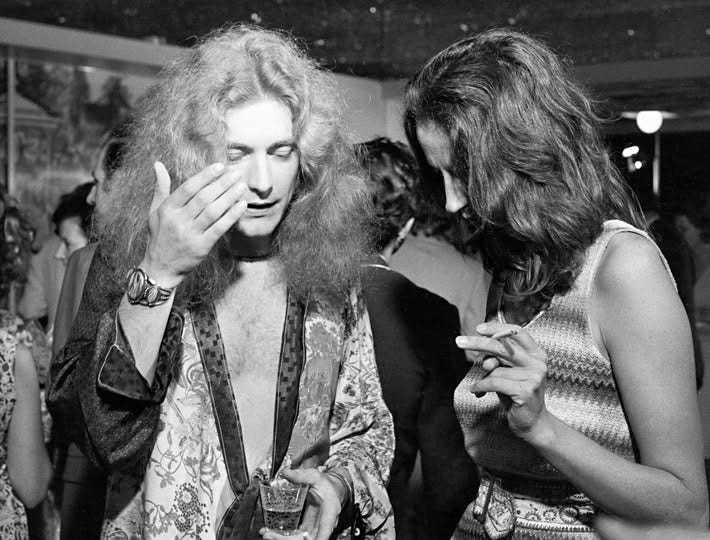
But it is possible to be too reductive, and, in a focus on power and domination, completely fail to see that there is also something of value, beauty and meaning here. Take Led Zep again. As I watched the film it was impossible not to see their masculinity as something vital and creative with an archaic, primeval source. Germaine Greer, feminist pioneer though she was, recognised and admired this. Talking about a 1970 Led Zep concert at the Albert Hall in London, she called the band “the Wagner of rock and roll”, its display of masculine energy “transcendent” and saying of Plant: “The spring god Dionysus had arisen and was shaking his streaming red-gold mane on stage.” Greer’s admiration retrospectively identified a cultural moment in which feminism did not yet seek to neutralise or condemn this kind of masculinity, but to recognise and reckon with its force.
Although Greer’s words were uttered as part of a reflection some 40 years after the event, there is a clip of Greer interviewing the band backstage after the Zep played its only Australian tour which shows her interacting with exactly the force she identifies in her retrospective account. You can see her alert, thrilling self-consciousness, how she is hyper-aware of her own femininity and the impression she is making: yet she is feisty too. The tension in her body suggests that the normally effortlessly composed Greer is trying hard to be nonchalant; her studied way of smoking and playing with her hair; almost manic laughter; but her witty comments still crackle one after another. In other words, she is sitting there, back stage, pulling off this taut, exquisite balance between being a person in full control of herself, and being a woman in a forcefield.
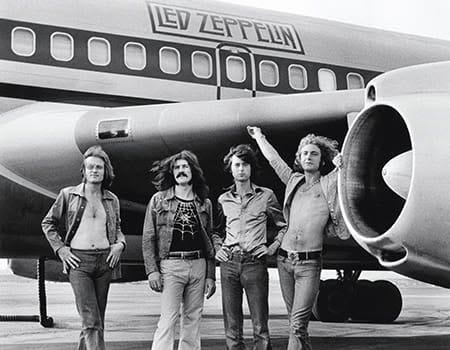
The Zep, meanwhile, are just being men, themselves, which is definitely easier for them. But still, they don’t get out of this unscathed either. In The Song Remains the Same the sensation of strength is threaded through with a poignant vulnerability. This is clear in the fantasy scenes: Robert Plant depicting his alter ego as a wistful knight of old engaged in mortal battles; Jimmy Page recognising his future self in an old man. Most of all it’s there in the last scene, as they leave the stage, get into the limousine and are driven to their iconic plane at JFK airport. We watch as the boys tousled and laughing, the late afternoon sun golden in their faces, leap lithely up the stairway in satin and flares – the steps not yet even fixed to the side – onto a plane that will bear them away into the future. We – their audience from the future – know exactly what that future holds for them: tragedy, death, loss. I wanted to shout at the screen: “No! Don’t get on!” Their bravado would not save them.
But perhaps the harder question is not how to survive enchantment – no one is denying that archetypal masculinity is dangerous for women – but how to live once it loosens its grip.
It was a helpful coincidence that, at the same time I was watching The Song Remains the Same I was reading Doris Lessing’s The Marriages of Zones Three, Four and Five, one of her fine feminist sci fi novels, written when she was 60. Lessing approaches the problem through allegory. Al·Ith, Queen of Zone Three, is required to marry the hyper-virile King of Zone Four, Ben Ata, by the command of the planetary Providers. Al·Ith’s zone, or country, is Lessing’s feminist ideal: men and women equals, the distinctions between femininity and masculinity (though not men and women) softened into a kind of androgyny, a non-possessive polyamory underpinned by an attitude of custodianship, devoid of possessiveness, to other species, and to the world itself. Ben Ata’s Zone Four, by contrast, is organised like a feudal kingdom, hierarchical, militaristic and of course patriarchal, with the kinds of masculine and feminine distinctions that are familiar to our own society and Ben Ata himself the ultimate example of hegemonic masculinity.
We watch what it does to Al·Ith as she is acculturated into Zone Four, succumbing to romantic love in our sense. She begins to feel jealous, possessive and insecure in her relationship with Ben Ata, and to lose herself. Where before she wore her emotions lightly, eventually she needs him to justify her existence.
During this time, the sexual obsession she feels is made tangible by the beating of a drum with no known source, sounding through the air of the pavilion they share. Its rhythms are inexorable, like a pulse; for me, as I read on, this drumbeat came to stand for enchantment itself: that overwhelming erotic and emotional pull which can reorganise a woman’s whole being in the world.
Time goes by.
And then one day it stops.
She leaves. Returns to Zone Three. It is over.
She is relieved to be free of the intensity, to return to herself. But that self has been changed. She cannot go back to who she was. She has learned something about the stakes of love, about boundaries, about the cost of surrender. The experience alters her; even as she leaves it behind, it expands her sense of what she is, and what she must refuse. It has been hugely valuable, and destructive in equal measure. And she misses it. For years she listens for the drum to start up again. It never does. She thinks of him all her life, even if, finally, she no longer strains to hear the drum’s return.
I mentioned earlier Germaine Greer’s appreciation, like Al·Ith, of masculine enchantment, even as she was determined to hold her own, not to turn into prey. In 1999’s The Whole Woman, she explains how feminism failed to understand the importance of this tension and thought it would and should be swept away with equality: “Liberation struggles are not about assimilation but about asserting difference, endowing that difference with dignity and prestige, and insisting on it as a condition of self-definition and self-determination” she writes, basically articulating the philosophy she embodied back stage with Led Zep. Different, yet strong. Flirtatious, sexual, yet very much in charge of herself.
To find a way of loving that does not demand the erosion of the self, nor alternatively a destruction of the masculine and feminine, is possible, though not easy. It is, however, an essential part of living in the Valley.
For some, the solution is to turn one’s back on the quest for an equal love and to settle into the single life. That was Greer’s answer later in life, after the drum had gone silent. She bought 60 hectares of degraded rainforest at Cave Creek, on the Australian Gold Coast, at the age of 62 and threw all her efforts into addressing the damaged ecosystem, choked with invasive weeds and fast-growing alien plants. She explained, of her motivation: “I was in search of heart’s ease and this was my chance to find it”, during a time in her life when she had already left behind her vanity and feminine self-consciousness.
Greer describes herself as having fallen in love with the land, and her communion with nature.
My own accommodation is more modest and sewn into the fabric of every day life, yet glorious in its very ordinariness. Somehow I have arrived at a point where my relationship is without games or drama. It is also without rigid sex-defined roles, where I go out to work and he cooks, cleans, and makes use of his gift of turning anywhere he happens to be – from a hotel room, to a container in the desert – into a home. We have adventures together and he is braver than me and better at navigating the land. My attention is focused outwards: I cannot remember the last time I allowed myself to be distracted by working out what he was thinking or feeling. Communication is kind, though not telepathic. We still have arguments. But they do not land with the violent force of a summer storm and are quick to resolve. We see each other as people not as archetypes or myths; that allows us to treat each other with true kindness.
And yet, watching The Song Remains the Same, I admit I heard the drum again and felt a brief, sudden grief, as if I had both escaped enchantment and, at the same time, lost everything worth living for.
A few mornings after watching the film, I walked into a coffee shop and saw a man, the first time in twenty years, who I had once had a massive crush on. I had been only his booty call, but he had made me weak at the knees. He was confident, casual, cruel, probably without even really knowing it. Between our unpredictable (to me) meetings, I had obsessed about him but I am sure he never gave me a thought.
And there he was drinking his coffee: middle-age, balding, tired-looking. His crackling fire had died completely. He was shockingly ordinary now, walking around without his former forcefield.
Despite the fact that he did not interest me now in the slightest, vanity kicked in and I hid behind sunglasses, partly so he would not judge me as I was now, older; but more, so he would not see that I felt nothing. It seemed wrong, somehow, a dishonouring of enchantment itself. Much better to remember us both as we had last seen each other: leaping up that stairway to the future, hopeful, vulnerable, radiant, without a clue as to what would find us there.
A very good read. Thanks.
Yes, I did fall for and marry, and leave, and was left, by more than one of the Robert plant types. I often reflect on that, I can’t really judge - seemed I couldn’t imagine coupling with someone who wasn’t uber masculine in that extremely androgynous and irresponsible way.
Since retiring from high romance with all its catastrophe I am lucky to be able to live alone, with gorgeous dog, in comfort. My daughter, sensibly married just thinks I’m a bit shallow on that front. And I get it. Oh dear. She does make me laugh. Mind you she married sensibly not being at all attracted to beautiful confident charismatic irresponsible men so she should probably thank me.
Just ordered ‘The Marriages Between Zones 3, 4 and 5’ I missed that one. But I remember ‘Summer Before the Dark’ deeply changing me; of my perception of my self, of my performative potential selves of which I was unaware. And it’s always a joy to read about Greer.
Great essay.
Thanks so much and your man seems like a keeper. Good company is a jewel to be treasured. I see that now. Never mind
Fantastic essay, thank you.
I just paid $300 for a ticket to see Robert Plant perform. Something of that spark is still there, see for yourself (on the Colbert show, 3 months ago):
https://www.youtube.com/watch?v=Ca3VI4aGDjc